
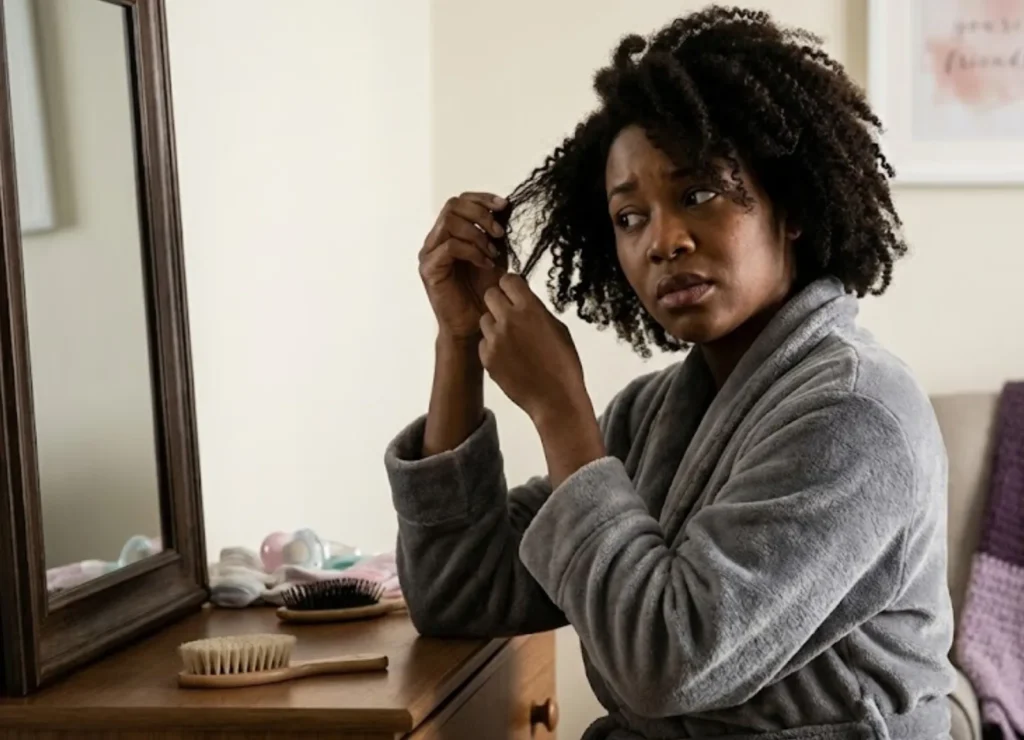
Becoming a mother is one of those life shifts that reshapes everything at once; your body, your routine, your sleep, even how you see yourself. In the middle of feeding schedules, recovery, and learning a new rhythm with your baby, you may notice that your hair begins to change. For many women, this shows up as postpartum hair loss. It can feel sudden, even unsettling, especially when you are already adjusting to so many other changes. But in reality, it is a well-documented part of the postpartum journey and usually temporary.
During pregnancy, hormone levels remain high in a way that extends the normal growth phase of your hair. This is why many women notice fuller, thicker hair during that period. After childbirth, those hormone levels begin to return to their pre-pregnancy state. As this shift happens, hair that would have naturally shed over several months often falls out within a shorter window. It is not damage or illness, it is a delayed cycle catching up.
Seeing more hair on your brush, pillow, or in the shower can feel discouraging, especially when you are already managing the demands of a newborn. It is easy in those moments to feel like something is going wrong with your body. But this phase is not a sign of decline. It is part of a reset process your body goes through after pregnancy. Most women notice that this shedding peaks a few months after delivery and gradually slows down on its own.
This is also a time that quietly tests how you see yourself. When your energy is low and your appearance is changing, it is easy to focus only on what feels different or lost. But this stage asks for a gentler perspective. Your identity as a mother is not reduced by changes in your hair or body. It is expressed in the care you are giving, the patience you are learning, and the presence you are building for your child.
As your hormones continue to stabilize, your body begins to adjust again. Over time, you may notice small new hairs growing in, especially around your hairline. This is a normal sign that the shedding phase is easing and your natural growth cycle is returning. It does not happen overnight, but it does happen steadily for most women without any medical intervention.
What helps most during this period is not pressure, but patience. Simple care like eating balanced meals, staying hydrated, avoiding unnecessary stress on your scalp, and giving your body time to recover supports the process more than constant worry or comparison. If shedding feels extreme or continues for an unusually long time, it is always wise to seek medical advice, just to rule out other underlying conditions.
At its core, postpartum hair loss is not a setback. It is a transition. A visible reminder that your body is recalibrating after one of the most intense physical experiences it will ever go through. When you understand it this way, it becomes less about loss and more about adjustment.
So when you notice the strands falling, try not to interpret it as something going wrong. Instead, see it as part of a larger process of renewal already happening quietly beneath the surface. This season will pass, as all postpartum phases do. And in time, what remains is not just regrowth in your hair, but a deeper sense of strength in yourself as a mother.