
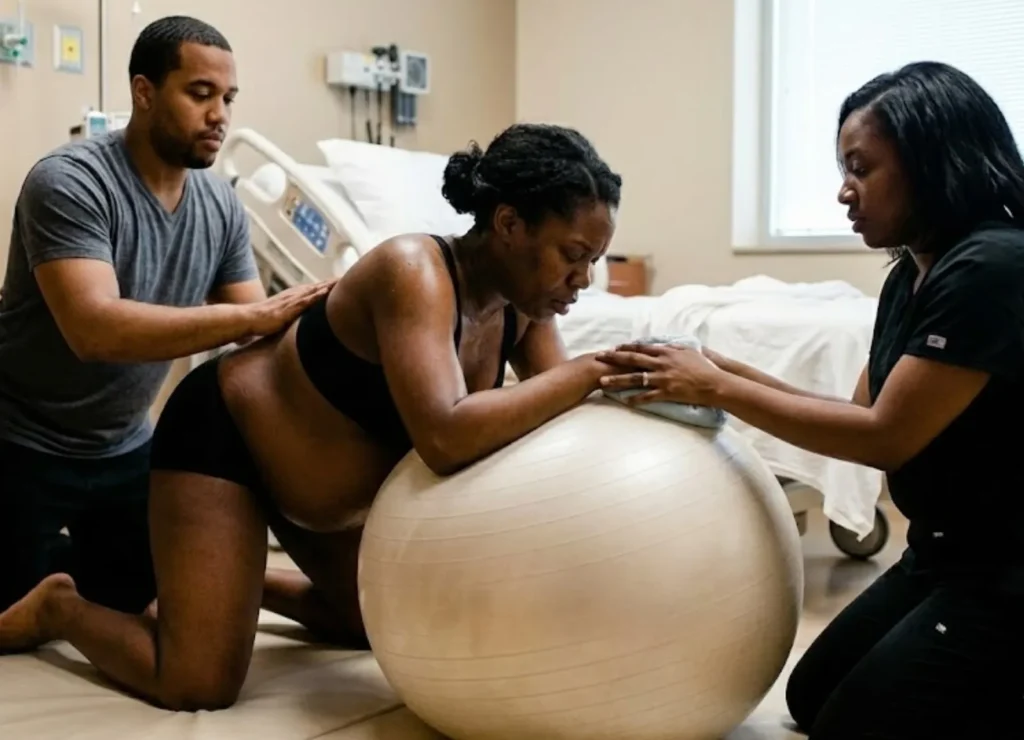
Most women spend months preparing for pregnancy. They read about what to eat, what to avoid, how their baby is growing week by week. But when it comes to the moment of birth itself, specifically the pushing phase, many women arrive without knowing that they have a choice in how they position their body, and that this choice matters. The position you birth in affects how long the pushing phase lasts, how much pain you feel, how well your baby tolerates the process, and how your body heals afterward. That last part connects directly to your postpartum recovery. So let us talk about what your options actually are and what each one does.
Why most hospital births default to one position
In most hospitals, women give birth lying on their backs with their legs raised. This is called the lithotomy position. It became the standard in institutional birth settings largely because it is convenient for the clinician in the room. It is not always the most helpful position for the mother.
When you lie flat on your back in late labour, the weight of your womb presses on major blood vessels. This can lower your blood pressure and reduce blood flow to your baby. It also means you are pushing against gravity at the moment when gravity could be working with you.
You are allowed to know this, and you are allowed to ask about alternatives.
Upright Positions
Standing, sitting upright, or using a birthing stool are all upright positions. They use gravity to help your baby move downward through the birth canal. Research consistently shows that upright positions are linked to a shorter pushing phase, less pain, and fewer assisted deliveries compared to lying flat. Your uterus also contracts more strongly when you are upright.
If you are able to move freely during labour, spending time in an upright position during the pushing phase is worth discussing with your birth team.
Hands and Knees
This means being on all fours, with your hands and knees on the bed or floor. It takes the weight of the baby off your spine, which makes it particularly helpful if you are experiencing back labour, where the pain sits heavily in your lower back.
It also gives your baby more room to move and can help if your baby is in a position that is making labour harder. Many midwives recommend it specifically for this reason.
Side-Lying
This is the position I want you to pay close attention to, because it is the one most women are never properly told about.
You lie on your side, with your knees bent and your upper leg supported, either by a pillow or by your birth partner. That is the whole thing. It sounds simple but the evidence behind it is not simple at all.
Research shows that women who give birth in the side-lying position have some of the best outcomes for perineal protection. The perineum is the area of tissue between the vagina and the bottom. Tears and cuts in this area are very common in childbirth and they directly affect your postpartum recovery. How you sit, how you walk, how you heal in those first weeks after birth can all be shaped by what happens to your perineum during delivery.
In one large study, more than two thirds of women who birthed on their side had no tears requiring stitches at all. A more recent study found that first-time mothers using the lateral position had a significant reduction in episiotomy rates and in moderate perineal tears specifically. An episiotomy is a cut sometimes made to help the baby out. It heals like any wound and can be uncomfortable for several weeks.
Side-lying also eliminates the blood pressure problem caused by lying on your back, because the weight of the womb moves away from your blood vessels. Blood flow to your baby stays steady throughout the pushing phase.
This position works particularly well if you are exhausted after a long labour. It also works well if you have had an epidural and cannot move around freely. And it gives your midwife or doctor better access to support your perineum during the final moments of the birth, which is part of why outcomes tend to be better.
Midwives in France have used side-lying as their preferred delivery position for many years. They have very low rates of episiotomy. That pattern is not coincidental.
Squatting
Squatting widens the pelvic opening and aligns the baby with the birth canal. Gravity assists the descent. For some women it feels instinctive and powerful during the pushing phase.
Supported squatting, where you hold onto a bar, your birth partner, or a rope attached to the bed, helps if you find it difficult to hold the position on your own. It is worth knowing that squatting does carry a higher rate of perineal tears compared to some other positions, so it works best when your midwife is able to support your perineum carefully during the final moments.
Hands and Knees in Water
Water birth positions allow the water to take some of the weight off your joints and muscles. Many women find that being in water during labour reduces pain significantly and creates a sense of calm that helps them manage the intensity of the pushing phase.
Water birth is not available everywhere, and it requires specific facilities and a birth team trained in it. If it is something you are interested in, ask your care provider early in your pregnancy whether it is an option at your birth setting.
Supported Positions
Any position can be made more sustainable with good support. A birth partner, a midwife, a birthing ball, a bed bar, or even a pile of firm pillows can make the difference between a position you can maintain and one you cannot. The best position is the one your body can actually use during the work of pushing.
What to do with this information
Before your birth, have a conversation with your midwife or obstetrician about positions. Ask what is available in your birth setting. Tell them your preferences. Write them in your birth plan if you have one. Prepare your birth partner so they can speak up for you when you are in the middle of it and focused on other things.
Position conversations are not about being difficult, they are about being informed. A mother who knows her options before she enters that room is a mother who can advocate for her body at one of the most important moments in her recovery story.
How you give birth connects to how you heal. And healing well is the beginning of everything that comes next.
Dr Megor Ikuenobe is a medical doctor, early childhood development specialist, and founder of Omugwo Academy.